Saturday, 6 August 2016

All Songs, Best to Worst: PJ Harvey

   So back in April I wrote some articles on Guns N' Roses and it was a hoot, so I figured I'll try writing something else music-related. I heard that in June Consequence of Sound ranked every Red Hot Chili Peppers song – all 236 of them – from best to worst. It's a brilliant idea, right? Why didn't I think of that? I thought it would be cool to do the same to an artist that I really like. And that's what I'm going to do here, starting with PJ Harvey's 107 songs. The first time I listened to PJ Harvey's music was in 2012 (when I tried Rid of Me) and since then I've been working my way through her discography to the point where I now own all nine of her albums.
   “Who is PJ Harvey?” you might ask. Polly Jean Harvey is an alternative rock singer/songwriter/multi-instrumentalist from Dorset, England. She's probably most well-known for her 90's works, though her 21st century material has seen plenty of success as well (she's the only artist to have won the Mercury Prize twice). I guess what drew me into her type of music was the raw emotion of her vocals, the stark lyrics, and the instrumental intensity of her 1990's material. Over the years her albums have taken on a wide variety of musical genres. Her first three albums were very alternative, with an indie rock feel and mix of blues rock as well. The fourth album, Is This Desire?, was again alternative, but was more experimental and had some electronic elements. In the first half of the 2000's, PJ Harvey released two more alt-rock albums, the first with a more pop feel (but still good) and the second which was kind of all over the place in terms of genre, but still raw and unpredictable. Harvey's sound took a sharp turn with the release of 2007's White Chalk, a piano-driven album that delves into the realm of gothic eeriness. Her latest two albums – the latter of which was released just three months ago – continued the trend of PJ singing in a higher register about social issues and history in an indie/folk rock style. In short, no two of her albums sound alike.
   If any of this sounds interesting to you, then I'd advise checking some of these songs out starting at the top. And just for the record, this list only includes songs from PJ Harvey's nine studio albums. This list won't contain “Shaker Aamer”, any collaborative songs, or any special edition-type releases. So here we go.

1. “Dress”, Dry (1992)
2. “A Place Called Home”, Stories from the City, Stories from the Sea (2000)
3. “Down by the Water”, To Bring You My Love (1995)
4. “Send His Love to Me”, TBYML
5. “Rub 'til it Bleeds”, Rid of Me (1993)
6. “The Last Living Rose”, Let England Shake (2011)
7. “The Wheel”, The Hope Six Demolition Project (2016)
8. “Happy and Bleeding”, Dry
9. “Rid of Me”, ROM
10. “Let England Shake”, LES
11. “Oh My Lover”, Dry
12. “Is This Desire?”, Is This Desire? (1998)
13. “The Life & Death of Mr. Badmouth”, Uh Huh Her (2004)
14. “A Perfect Day Elise”, ITD
15. “When Under Ether”, White Chalk (2007)
16. “To Bring You My Love”, TBMYL
17. “Beautiful Feeling”, SFTCSFTS
18. “On Battleship Hill”, LES
19. “The Words that Maketh Murder”, LES
20. “Fountain”, Dry
21. “C'mon Billy”, TBYML
22. “The Devil”, WC
23. “Sheela Na Gig”, Dry
24. “All and Everyone”, LES
25. “O Stella”, Dry
26. “Big Exit”, SFTCSFTS
27. “This is Love”, SFTCSFTS
28. “The Garden”, ITD
29. “Legs”, ROM
30. “The Glorious Land”, LES
31. “Good Fortune”, SFTCSFTS
32. “My Beautiful Leah”, ITD
33. “The Community of Hope”, TH6DP
34. “Hanging in the Wire”, LES
35. “Water”, Dry
36. “The Dancer”, TBMYL
37. “The Wind”, ITD
38. “River Anacostia”, TH6DP
39. “Pocket Knife”, UHH
40. “Silence”, WC
41. “One Line”, SFTCSFTS
42. “A Line in the Sand”, TH6DP
43. “Hook”, ROM
44. “Man-Size”, ROM
45. “Dear Darkness”, WC
46. “You Come Through”, UHH
47. “Ecstasy”, ROM
48. “The Mountain”, WC
49. “The Letter”, UHH
50. “Meet Ze Monsta”, TBYML
51. “Working for the Man”, TBMYL
52. “The Whores Hustle and the Hustlers Whore”, SFTCSFTS
53. “Grow Grow Grow”, WC
54. “The Ministry of Social Affairs”, TH6DP
55. “To Talk to You”, WC
56. “The Slow Drug”, UHH
57. “Victory”, Dry
58. “Plants and Rags”, Dry
59. “You Said Something”, SFTCSFTS
60. “The Ministry of Defence”, TH6DP
61. “Hair”, Dry
62. “Missed”, ROM
63. “Me-Jane”, ROM
64. “Near the Memorials to Vietnam and Lincoln”, TH6DP
65. “We Float”, SFTCSFTS
66. “Angelene”, ITD
67. “Dry”, ROM
68. “Cat on the Wall”, UHH
69. “This Mess We're in”, SFTCSFTS
70. “It's You”, UHH
71. “Long Snake Moan”, TBYML
72. “Who the Fuck?”, UHH
73. “Shame”, UHH
74. “No Child of Mine”, UHH
75. “The Orange Monkey”, TH6DP
76. “Catherine”, ITD
77. “In the Dark Places”, LES
78. “Before Departure”, WC
79. “Snake”, ROM
80. “The Desperate Kingdom of Love”, UHH
81. “The Sky Lit Up”, ITD
82. “Chain of Keys”, TH6DP
83. “White Chalk”, WC
84. “Kamikaze”, SFTCSFTS
85. “50 ft Queenie”, ROM
86. “The Piano”, WC
87. “Electric Light”, ITD
88. “The Darker Days of Me & Him”, UHH
89. “The River”, ITD
90. “Horses in My Dreams”, SFTCSFTS
91. “Joe”, Dry
92. “Teclo”, TBYML
93. “Written on the Forehead”, LES
94. “Medicinals”, TH6DP
95. “Yuri G”, ROM
96. “Dollar, Dollar”, TH6DP
97. “Bitter Branches”, LES
98. “Joy”, ITD
99. “Broken Harp”, WC
100. “Highway 61 Revisited”, ROM
101. “The End”, UHH
102. “England”, LES
103. “I Think I'm a Mother”, TBYML
104. “No Girl So Sweet”, ITD
105. “The Colour of the Earth”, LES
106. Untitled (seagulls), UHH
107. “Man-Size Sextet”, ROM


Wednesday, 3 August 2016

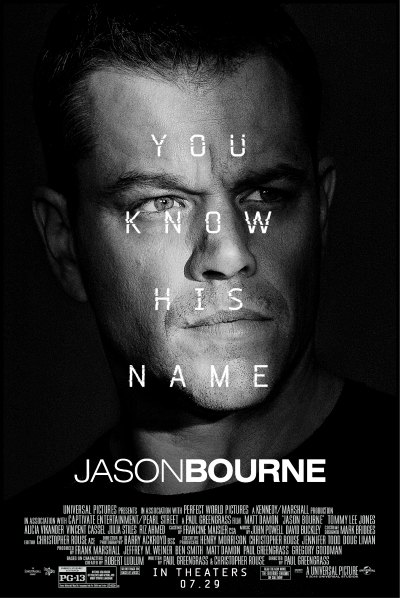
Movie Review - Jason Bourne

   Jason Bourne? What a lazy title for a series' fifth movie! Don't the producers know how a Bourne movie is supposed to be titled? It's supposed to be “Bourne” and then another word, not the main character's name. You guys passed up the chance to name it “Bourne Again”. The opportunity was right there, and oddly enough it would have been a fitting title since it alludes to how copy-and-paste this film's plot feels as well as to how superfluous it is to the series overall. But is it worth seeing?
   Uuuuugh!!
   And the award for Worst Cinematography Ever goes to Jason Bourne. The series' trademark rapid-cutting and the overly shaky camera is back with a vengeance and it makes most of the movie aesthetically offensive and unwatchable. It makes Fast and Furious 3: Tokyo Drift look like freakin' Birdman. I'm serious, I sat in the front row for this thing and I felt a bit sick by the end. This incoherent style of editing totally ruins the action scenes, and when it's time for a vehicle chase scene, just forget it. You won't be able to tell who's in which car, where they're going, and where they are in relation to each other. The camerawork is so bad that it can even screw around with the audience's perception of important plot points. SPOILER ALERT, when it gets to the point where my two companions and I couldn't tell how the last bad guy died, you know you done f***ed up something bad. You know, I actually kind of feel sorry for the guy who has to edit this stuff together. He has to take what's probably some really cool and elaborate action sequences and chop them up into lightning-quick montages of incomprehensible crap. This movie had the potential to be awesome, but it was smothered by the director's overbearing style. I know I'm going on and on about the same problem, but it really is a huge obstacle to enjoying this film.
   You'd think that since this is Matt Damon's return to a beloved series that's been semi-dormant since 2007 (if you don't count the black sheep of the franchise, Legacy) that they'd maybe try something new or change up the formula a bit. But no, it's the same plot as all the others. A shady high-ranking CIA dude who's at risk of being publicly exposed tries to hide evidence of his wrongdoing by sending an assassin to go kill off his former agent, Bourne who tries forming an uneasy partnership with a female agent on the inside. It has a lot of other Bourne movie conventions as well: Bourne remembering stuff from his past, going to Germany, people constantly saying the word “asset”, and shots of computer screens (at least the camera holds still long enough to see them). It's a by-the-numbers plot. The most I can say is that the relationship between Bourne and the bad guy assassin – played by Vincent Cassel – is more interesting than the other films.
   At least the acting is pretty good. Matt Damon is good as usual. Unfortunately, his character is starting to get pretty uninteresting. Despite her supermodel looks, Alicia Vikander plays her role as a CIAgent convincingly and with an air of professionalism. It's too bad that her American accent isn't very good.
   Overall, Jason Bourne is a semi-competently made film. It isn't horrible, but it sure pissed me off. If you're an addict for hardcore Bourne-ography then this will probably satisfy you. But if you're like me and you actually like to see the movies you watch then for the love of Pete, stay away! Run for your lives! After all, what is the point of an action movie in which you cannot see the action?

Grade: two out of five.

Saturday, 30 July 2016

Movie Review Repost - The Bourne Legacy (2012)

So a new Bourne movie is out now and I hope to see it very soon. I've seen most of the Bourne movies and I liked most of them. But I didn't quite like the fourth one: The Bourne Legacy. So today I'm gonna take a trip down memory lane and show you the review I wrote for that film four years ago. My thoughts on this film are pretty much the same as they were then... I think. I've only ever seen Legacy once, but I'm starting to think that Renner's character was actually more interesting than Bourne ever was. Enjoy!

   It's time for a new Bourne movie: the Bourne Redundancy... er, I mean Legacy. With a different director and a new lead actor we now have a fresh new take on the Bourne series.
   The one thing that Legacy has going for it is its acting. Jeremy Renner gives a great performance as our new hero Aaron Cross. He comes across as more likeable than Matt Damon's Jason Bourne (who is not present in this outing) ever was, though not nearly as sympathetic and interesting. For most of the movie Cross is accompanied by Dr. Shearing played by Rachel Weisz. Her performance is excellent despite starting out as a tad annoying.
   The plot is kind of hard to explain: it somehow manages to be both too similar and too different to the other movies. Legacy continues the Bourne movie tradition of not having anything to do with the books. Taking place immediately after Ultimatum, this film begins with the FBI investigating the CIA after Jason Bourne has publicly exposed the Treadstone and Blackbriar Operations. Because of this a few high-ranking CIA officers decide to wash their hands clean and liquidate all the assets of their illegal projects. So yeah, this is basically the same plot as the other movies: a shady CIA officer tries to clean up his own mess by killing the main character. It's starting to get old and as always it takes about 15-20 minutes to figure out what's going on.
   Anyways, remember in the other Bourne movies how the final boss (AKA: the last bad guy) was always there trying to get Bourne from the start? This movie quickly and casually introduces the assassin – Larx-03 – within the last half hour. Towards the end, our heroes partake in a motorcycle chase that lasts way too long and becomes kind of boring. This is immediately followed by a very abrupt ending.
   To summarize, this just doesn't feel like a Bourne film. There's no Jason Bourne. There's no Pam Landy. The first half hour of action takes place in the wilderness. There's only one gunfight. The whole film takes place in only two countries. These aren't necessarily bad things, but you can see where I'm going with this. The only things consistent here are the things you already didn't like: overused plot lines, annoyingly fragmented cinematography, and a somewhat misleading title. Bourne Legacy isn't horrible, but fans of the other movies will be disappointed after watching this one.


Final rating: two and a half stars out of five.

Saturday, 23 July 2016

Top 10 Worst Recurring Problems/Trends With Video Games

So last week we looked at some irritating aspects of video games that are overused and stereotypical. But when making that list there were a bunch more problems that I just couldn't let slip. I tried grouping these problems separately in that these are more like stupid directions/tendencies that video games as a whole seem to be heading towards rather than problems with individual games. Whereas cliches will have you simply rolling your eyes, these following problems are the ones that you should be genuinely concerned about in today's gaming industry. Or something like that. Just consider this the second half of last week's list if you want. Let's roll.

10 – Difficulty settings that you have to unlock
I will never understand this design decision, other than the fact that it tries to make you play through the game a second time. Why is a game's highest difficulty something that I have to earn? It should be something that's available right at the start. This is just lazy; unlockables in video games are supposed to be rewarding, not basic necessities. What's worse is when you're playing a sequel of a series that you're already well familiar with – like me when I first played Gears of Wars 3 and Judgment – and you can't have the challenge you want until you've already beaten the game once. C'mon, man! Veteran players already know how this game works. Don't treat the player like a baby.

9 – Unskippable End Credits
Same as last week's #1 worst cliche, but slightly less aggravating. These are just credits and it is the end of the game, so you could just get up and do something else while you're waiting for them to finish. However, the end of the campaign is supposed to feel satisfying and rewarding, not tedious and punishing! Developers, I know a lot of hard work went into your game, but c'mon, we already paid money for the damn thing. Be thankful for that and call it a day.

8 – Clumsy Weapon/Item Switching
Don't you just hate it when you're in a tight jam and you need to use a weapon or item quickly but the controls just won't allow you to do it? Video games – action games, especially – need to have a way to swiftly select things. Otherwise you'll get screwed sooner or later. Even though I consider it a great game, Far Cry 3 has caused me a lot of grief in this category. In this game you switch weapons by holding the left shoulder button and selecting the weapon with the thumbstick, which is OK but it would've been better if this was mapped as a simple press of the D-pad. Instead the D-pad is used for your camera, throwing rocks, and two random syringes – and you'll never remember exactly which syringes they are. To heal you have to press and hold the Y button, which is a pain in the ass. Holding the Y button takes too long and it doesn't even work for about 1/3 of the time. This “hold Y” bullcrap is the cause of probably 80% of my deaths in Far Cry 3. Other than that, if you want to use anything else you have to painstakingly do it from the start menu, bringing the gameplay to a screeching halt. What a load.

7 – Sequels that change up the controls
You've just bought the latest game in one of your favourite video game series. You pop the disc in. You start the game aaaaaaaaand... the controls are totally different from before. Dangit! Most of the time it isn't a huge big deal, but every once in a while they change up something critical to your survival/success. Like in Gears of War: Judgment, where I wasted a ton of grenades all because the objective/squad status button has been replaced with the grenade throw button. What's worse is when in one game the controls are really awkward and different and then in the next game they go back to being fairly straightforward. For instance, playing Splinter Cell: Blacklist right after playing SC: Conviction is a complete mess. I end up crouching when I'm trying to reload. I've aimed when all I wanted was to get into cover. I've leaped into cover when I wanted to perform a melee takedown. I've been spotted a lot because I pressed the “attract” button, expecting to see what the objective is. And worst of all, I've wasted so many gadgets just trying to crouch! Thanks, Conviction. You completely screwed up the following (and, might I add, much better) game.

6 – Short Single-player Campaigns
I know I'm definitely in the minority here, but I spend a lot of time playing the single player mode of video games. In fact, I don't think I've ever gamed online (with consoles anyways, I've done it before with PC games). To me at least, the meat of a game should be its single-player campaign; the multiplayer is the icing on the cake... of meat. (And if we're talking about a game that's multiplayer-only, then forget it.) That's why it really bothers me that a lot of games nowadays seem to be geared much more towards multiplayer with ever-shortening campaign modes of less and less creativity. It breaks my heart to see such games as the newest Star Wars: Battlefront have a campaign that's less than a couple hours long, especially when the original Battlefront games actually tried to do a fun single-player story mode. And that was over a decade ago! You'd think that games without a campaign mode would instead have a mind-blowing, revolutionary multiplayer mode where all their effort was directed, but for the most part multiplayer games haven't changed all that much in the past few years. And then there's the games that are single-player-only but they still have very short campaigns, like The Order: 1886. What's their excuse? Out of respect they'd better not be full price, because there really is something to be said of games with which you'll be completely finished in just one or two sittings.

5 – Difficulty Spikes
In video games, difficulty should be increased gradually in increments. But sometimes a game will unexpectedly crank up the hardness, which isn't very fair to the player especially when it's for no apparent reason. For example, about 2/3 of the way through Rainbow Six: Vegas 2 – a squad-based tactical shooter – you're sent on a mission to clear out an oil refinery. Not only are there snipers everywhere, dozens of bad guys waiting around every corner, and exploding hazards all over the place, but also your squad has been taken away and you have to do this all by yourself. Oh come on! This is supposed to be a tactical shooter, so why don't I have my squad with me? I tried playing this game through on the highest difficulty setting, but this is where I got stonewalled and gave up. There are other times when the developers can't think of a decent challenge for the last level so they instead just throw everything and the kitchen sink at you. This rarely goes over well, as was the case in such games as Battleship (2012), Rambo (2014), and Deadpool (2013). Way to go, guys.

4 – Unclear objectives
I know I complained about hand-holding and intelligence-insulting tutorials last week, but sometimes the exact opposite problem can bug the crap out of you. Designing video games requires a delicate balance between directly stringing the player along and just dropping him in the middle of nowhere with no clues at all of what to do. Everyone has at some point played a where-the-frick-do-I-go type of game. Every time that happens to me – like in Half-Life 2 or Tomb Raider: Legend – I find myself thinking of the Coldplay lyrics: “Where to, where do I go?” That's right, you can tell that even Chris Martin has gotten stuck in video games with unclear objectives. This issue is why I've come to hate Red Dead Revolver so much. Right now I'm about halfway through that game and there's hardly been a single level where I didn't have to look up what to do. Would it have been too much for them to just drop a hint every now and then? If this ever happens to you, here's what to do: keep your phone handy, then when you get stuck speak the words that I've repeated countless times over the years: “Almighty YouTube, show me the way!” The sad part is that if this happened to you in the age before YouTube and the internet then you were screwed, sometimes permanently.

3 – Not Enough Checkpoints
This one's self explanatory. Video game levels that have only a couple save points are never an easy affair, and it's the kind of problem that you only notice when you're doing a hard level. I'm the kind of guy who doesn't like having to redo things over and over. It's incredibly frustrating, another reason why I don't like Red Dead Revolver very much. That's why games with quicksaves are da bomb. That way if you screw up/die you can pick up at that challenging spot right away (if you saved) instead of having to go through hell and back just to try it again. Be careful though, because games that have quicksaves like Doom 3 and Splinter Cell: Chaos Theory sometimes have no checkpoints at all. And of course you'll never find out until you die for the first time and are forced to restart the entire level all over again.

2 – No Couch Coop/Local Multiplayer
WHY?!?!?!?!?!?!?!?! Yeah I know that online gaming has revolutionized the video game industry and all that bullcrap, but come on! Video games are most fun when you're playing with a friend; you know, a friend who's in the same room as you. Same-screen gaming has been a part of video games for as long as anyone can remember, even in the days of Pong and Magnavox Odyssey. Since when did the idea of two or more people playing together on the same screen become obsolete? Why take it away? I'll tell you why: it's a blatant attempt to force people into buying more consoles and copies of games. I think my heart skipped a beat when I learned that Halo 5 was not going to have splitscreen. That's right, the thing that Halo did best, the thing that made that franchise what it is today is now lost and gone forever. To me that's as crazy as a sports game not having local multiplayer. According to Angry Joe, it's all because of a new prevailing doctrine amongst developers/publishers known as “F--- you! Give me money!”

1 – Preorder/DLC/Microtransaction culture
This may not come as a shock since I just mentioned that I'm not much of an online type of gamer, but I do think that this problem is a huge waste of time and money for lots of people. Let's face it: video games aren't cheap, so when I buy a new game for full price I expect a full game. I don't want to install anything. I don't want to have to wait for things to update. I don't want to have to download a bunch of extra content to wind up having a complete gaming experience. I understand that not all DLC is bad. Patches that fix coding problems are OK. Paying a few extra bucks for additional maps and campaign levels is OK, but when it gets to the point where the release-state of the game is really only half a game – Star Wars: Battlefront (2015), anyone? – something has gone horribly wrong. A lot of downloadable content is just stuff that should've been included in the game already. What's worse, when it gets to the point that you have to pay additional money just to unlock/activate items or characters that are already clearly on the disc (i.e. you've already paid for them) it's obvious that the developers/publishers have lost their way and only care about the money. Capcom and Ubisoft should be ashamed of themselves. In the more complete games of the past, the player would unlock these things by completing some challenge or using good old-fashioned cheats. Nowadays it's all microtransaction this and preorder that.

In conclusion, when I play a video game all I want is the console, the controller, and the disc/cart that the game comes on. That's probably why I like old school gaming so much. I guess I'm a man of simple tastes. Thanks for reading.

Wednesday, 20 July 2016

RMS Republic drawing: 1000 Pageview Special

Guess what, guys! Today Anachronarchy received its 1000th page view! Thank you readers so much for all the support. I hope you've had half as much fun reading this blog as I've had writing it for the past 9 months.
As an expression of gratitude I'm posting a drawing I did a few weeks ago of the RMS Republic, a White Star Liner that sank after a collision in 1909 just off of Nantucket. It marked the first time a wireless distress signal had been used, and even though there wasn't enough space for everyone on the lifeboats there were enough nearby ships to assist. Nobody died as a result of the actual sinking (the collision did kill a few). Unfortunately this incident only bolstered shipmakers' faith in their own imperfect safety procedures, culminating in the massive loss of life from the Titanic's sinking three years later.
Anyways, this drawing was done entirely with pencils and took 7 hours to complete.

Saturday, 16 July 2016

Top 10 Worst Video Game Cliches

Back in February I wrote a list of what I think are the top 10 worst movie cliches. This week I've decided to list the most annoying cliches found in video games. Video games are lots of fun, but all it takes is one little thing to totally spoil each one. For this list I've included aspects of games that I feel are unoriginal and overused. If a common gaming problem you hate didn't appear here, then check out next week's list of top 10 video game trends.

10 – Your Helicopter is Shot Down
Just a minor complaint here, but you ever notice that helicopters in action games crash/get shot down a lot? And by a lot, I mean all the time. And with each instance, it becomes more and more predictable. It happened in Halo: Reach. It happened in Splinter Cells Conviction and Blacklist. The Call of Duty series especially abuses this stereotype. Your helicopter gets shot down in Call of Duty: Advanced Warfare, at least twice in CoD 4: Modern Warfare, and no less than three times in Black Ops. And your character always walks away without any bone fractures as if it was nothing. It's a miracle to survive one helicopter crash, let alone three! Bottom line: helicopters in action games are death traps. Don't enter one!

9 – Quicktime Events
I'm sure you've heard people complain about this one a lot, but it really is that big of a problem. It isn't so much irritating as it is disappointing. There's three reasons why. First, the demanded button presses are often counter-intuitive as to the action you're supposedly performing. For example, twirling the thumbsticks around would work if the player's character was spinning or rotating something, like the lock-picks in Splinter Cell or Skyrim. But how does alternately mashing the triggers simulate pushing things away, Ultimate Spider-Man? How is pressing three random buttons anything like using a rolling pin, Fable 3? The second problem is that the button prompts that you're supposed to be keeping an eye on usually force the player to look away from where the action is. You'll end up not even seeing the result of your button presses because you're too busy keeping alert for the next button prompt! And third, quicktime events are just boring and not fun. How many times have you made it to a final boss, excited to kick his butt, only to find out that you need only press a few buttons to win. QTE sequences take control away from the player, leaving him/her only with the ability to choose how long the sequence continues. For this reason, a failed QTE attempt feels all the more frustrating and cheap. In short, quicktime events should be relied upon far less because they take away the player's agency and reduce him/her to a passive observer of the action.

8 – Sequel-baiting
We truly live in the age of video game franchises. Hardly a any successful game goes by without being granted some sort of sequel. This isn't a bad thing, if the game has earned it. Unfortunately some games think that if they leave the game on a cliffhanger it'll have to warrant a sequel. They're wrong! Gamers want self-contained stories. It's OK to leave the door open for a followup – maybe one or two seemingly minor loose threads to be resolved later. But games like Half-Life 2, Kane & Lynch 2: Dog Days, Halo 2, The Walking Dead: Survival Instinct, The Order: 1886, and Homefront end so clumsily that they really do spoil the feeling of accomplishment you should feel upon completing a game. The proper way to secure a sequel is to do the game right the first time so that we want to play more of it; not by leaving out the game's ending, that's sloppy. What a shame.

7 – Regenerating Health
It seems that nowadays it's not often that you play a game that has a health bar which does not regenerate on its own. I play a lot of shooter games and in this genre regenerating health has pretty much become commonplace – even in tactical shooters which are supposed to be rooted in reality! I mean, having your wounds fully healed by touching a first aid kit wasn't all that realistic in the first place but it made a lot more sense than simply sitting still behind a wall for a few seconds. Not only that, but a non-regenerating health system encourages the player to explore the level, thus making exploration more rewarding: I'm looking at you, Halo 2. Also, multiplayer games that use regenerating health are typically littered with useless weapons that aren't powerful enough to kill enemies quickly – i.e. pistols have gotten the shaft lately. In my opinion, regenerating health is only useful if you're playing on an extreme difficulty or if the game you're playing has a really poor checkpoint/save system.

6 – You're the only competent one around
Don't you just love games in which your AI allies are completely useless? The games that constantly and thanklessly bark orders at you to do other peoples' jobs? (Come to think of it, this is starting to sound like my job.) I know video games are supposed to make the player feel empowered, but could the NPCs please stop being so lazy? When it comes to the point where one man single-handedly turns the tide of a major battle, it gets kind of ridiculous. Call of Duty: Modern Warfare 2 unintentionally created an internet meme with its constant “Ramirez, do this!” and “Ramirez, do that!”, expecting the poor private to do everything.

5 – Intelligence-insulting Tutorials
Tutorials seem so lazy and boring nowadays. All they are are just uninteresting mini-levels that waste your time explaining how to do the most basic things. “Use right thumbstick to look. Pull right trigger to shoot. Press start to pause.” No, really!? I never would've figured that out on my own. Game developers need to realize that gamers aren't idiots and are capable of recognizing basic patterns that are found in performing actions in video games. When was the last time you played a video game that had an interesting tutorial? Most of the time games just plainly flash the instructions on screen with no creativity, not even trying to mesh the tutorial within the context of the level. More games need tutorials like Call of Duty 4: Modern Warfare or the original Splinter Cell, whose tutorials took place at obstacle courses on military training grounds. Those were cool. Or better yet, design the tutorial in a way that subtly guides the player through the basic moves without overt instructions, making the gamers feel as if they discovered it on their own. Wouldn't that feel more satisfying? Empower the players, man!

4 – Telling You To Hurry Up
Sections that have arbitrary time limits are bad enough, but how annoying is it when you're playing a level that is not time sensitive and yet the NPCs still have the gall to tell you to hurry up. This can often happen when you're trying to explore a level – the NPCs reminding the player of the level's/game's ultimate objective – in which case the gamer's typical response is “Screw you. I'll do what I want!” But other times it can be during just one part of a level in which the game is trying to instill a sense of urgency; if that's the case, then just put a time limit on that one small part. I won't mind. I especially hate it when the game tells you over and over that you need to do something and then doesn't bother to tell you how you're supposed to do it. Do you think I'm a retard?! Do you think I'm not trying?! Just shut up already!

3 – The Silent Protagonist
A fairly common convention in video games is to never have the player's character talk. The reasoning behind this is that it is easier for the player to project their personality onto the character and relate to that him/her. Unfortunately, this pretty much always results in that character having no personality of their own. This is why I don't understand people who think that Master Chief (Halo) or Gordon Freeman (Half-Life) are some of the greatest video game characters ever. How can you call them characters when they hardly say a word? With Halo it's not so bad because at least Master Chief talks during the cutscenes, plus Cortana is there to talk to you during the gameplay. But with Half-Life it is so boring because there are no cutscenes; Gordon Freeman never says a single word. Ever. Whenever people are talking to him, he comes off as some shy, timid dweeb. And yet everyone seems to know what you're thinking and what you need. In short, playable characters who don't talk are awkward, boring, and forgettable.

2 – Hand-Holding
In response to cliche #4, sometimes the complete opposite can pose a huge problem too. Like when the player is supposed to do something and some large, obtrusive instructions flash on screen and don't go away until you finally do that thing. I hate that crap. Most video games don't need those waypoint markers telling you who to follow/where to go. Most of the time, the person/destination is straight forward and the player can easily find it himself (if the game is designed competently, that is). And just like with regenerating health, waypoint markers don't encourage the player to explore the level. It's true that video gaming has become more accessible and casual in the past couple decades, but you don't need to dumb down the way gamers are expected to think. An example of this is the Splinter Cell games. In the earlier games, you were expected to figure out how to navigate and traverse the levels on your own. But with the later Splinter Cell games, tooltip icons pop up whenever you're in a position to do something. What's more, interactable/manipulable objects are often highlighted when you use your (sigh) sonar vision. It's almost as if the games are straight up telling you exactly what to do/where to go. Instead you'll find yourself repeatedly saying, “Yeah, I get it. Thanks.”

1 – Unskippable Cutscenes
I know that the story is an important part of the game that developers work hard on, but can't they just accept that people don't always want to watch them? Moreover, did it not occur to them that people often do multiple playthroughs and have already seen the cutscene? Making cutscenes in video games unskippable is just a dick move. It makes games like Destiny, Call of Duty 3, Max Payne 3, Assassin's Creed 3, and Metal Gear Solid 4 very hard to get into – and even harder to want to make you want to replay. Is this supposed to be fun? The worst offenders are unskippable cutscenes that come directly before a boss fight or other such difficult part where you're likely to die a lot: you're screwed. The Angry Video Game Nerd said it best when he remarked, “Is this what kids do nowadays: sit around and watch video games?!”

Saturday, 9 July 2016

Movie Review Repost - Furious 7 (2015)

In my review of Independence Day 2, I mentioned how the original Independence Day was a big, dumb pile of fun. So I thought now might be a good time to show you a review I did for one of those types of movies, Furious 7. Since April 2015 my feelings on this movie haven't changed; it's a prime example of mindless entertainment.

   It's once again time to return to that inexplicably long-running film series that keeps changing its title with each passing outing. I'd just like to point out that before Furious 7, the only Fn'F films I had previously seen were 2 Fast 2 Furious and The Fast and the Furious: Tokyo Drift, the latter of which you may remember (Who am I kidding? No, you don't) being on my list of Top 10 Worst Movies I've Ever Seen... my expectations were not high.
   But this one was alright. Furious 7 follows Dominic Toretto and his team as they take on a vengeful assassin working for a terrorist network. The film even dares to tie itself into the plot of Tokyo Drift, apparently becoming the first movie to take place after that one. Anyways, Furious 7 offers lots of wild, over-the-top action with impressive stunt work and lots of explosions. And to cap it all off, we're given a touching tribute to the late Paul Walker at the end.
   The film boasts an ensemble cast – Vin Diesel, Paul Walker, Michelle Rodriguez, Kurt Russel, Jason Statham, Dwayne Johnson, Ludacris, Tyrese Gibson – and they each do a fine job, even if their comedic banter doesn't always achieve the laughs they're going for. But the one-liners have just the right amount of cheesiness, and Jason Statham is an amazing villain. Paul Walker's passing, which no doubt contributed to this film becoming the fifth-highest grossing movie of all time, necessitated some obvious script rewrites. You can tell that his character was originally meant to have a bigger role.
   Probably this film's biggest problem is its editing. Besides having random fast-forwards and pointless jump cuts (seriously, was this shot in 2002?) Furious 7's fight scenes also suffer from that familiar choppy editing that nearly renders them unwatchable; this probably made it easier to pass off Walker's doubles. The driving scenes look OK though. The cinematography was a little high-strung as well; there's a lot of tracking and rotating camera shots for scenes that only have people talking. It's not necessary.
   Obviously Furious 7 is an over-the-top action flick, but there's just a few things that one's suspension of disbelief can't hold up. Like, why did agent Hobbs have his weapons and gear with him in his hospital room? How was Dominic able to lift up a suped-up million dollar car fitted with armour plating? And how do none of the drivers ever get hurt? Aside from walking away from nightmarish crashes without a scratch, I think every main character jumps out of a speeding car at least once. And not a single bone was broken. Needless to say, don't try this at home.
   I have to admit I was fully prepared to hate this movie, but it's actually not that bad. It's not your thinking man's action movie, but it's entertaining enough. It's the kind of movie Michael Bay wishes he could make; and since it isn't as boring it presents a decent alternative to the Transformers movies.


Rating: three stars out of five.