Saturday, 7 October 2017

All-Time Team: Vancouver Canucks (1970-present)


  Blast off! It's hockey time! Last week we looked at my picks for an all-time team for Pittsburgh, so now we'll go over the all-time fantasy roster for my favourite NHL team, the Vancouver Canucks. I've been a Canucks fan for much of my life, I own several of their jerseys, I buy a Canucks calendar pretty much every year (you know, those calendars that show players half of whom are no longer with the team by the time their month comes 'round), and I keep my eye on them even though I don't watch their games as frequently as I used to.
  As usual we'll begin with a brief history. The Vancouver Canucks entered the NHL in 1970 along with the Buffalo Sabres. Buffalo ended up winning first draw on both the amateur draft and the expansion draft, taking future Hall of Famer Gilbert Perrault. For some dumb reason Vancouver was lumped in with the East division. The competition here was fierce and the new expansion team didn't stand much of a chance, missing the playoffs in each of its first four seasons. Thankfully the league was reorganized, putting the Canucks in a much fairer position in the Smythe division; the team immediately won its first division title and earned its first playoff berth. By the end of their second playoff run in 1976, the team's original core – Orland Kurtenbach, Andre Boudrias, Jocelyn Guevremont – had left. Though there were good players around, the team was kind of directionless. And yet despite several years of awful regular season efforts the Canucks did make the playoffs six years in a row from 1979-1984. This was mostly due to the fact that there was usually one or two teams in the Smythe division that were even worse than Vancouver, usually Colorado or Winnipeg.
  Although the Canucks were pretty bad in the 1980's they still fielded some talented forwards who could put out a decent amount of points. By far the most exciting thing to come Vancouver's way in this time was their Cinderella run to the Stanley Cup finals in 1982. Despite never winning a playoff series before and going into the postseason with a losing record, the 'Nucks swiftly defeated the Calgary Flames, the Los Angeles Kings, and the Chicago Blackhawks while losing only two games in the process. This was largely thanks to stellar play from Stan Smyl, Thomas Gradin, and the dependable goaltender Richard Brodeur. Unfortunately they had to face off against the juggernaut New York Islanders in the finals and were swept in four games.
  The late 80's were tough for Canucks fans. The team was about as bad as it was in the early 70's, and it only made the playoffs twice (1986, 1989). After joining Vancouver as its general manager and president in 1987 Pat Quinn set the team on course for a rebuild, trading for players like Greg Adams and goaltender Kirk McLean and drafting players like Trevor Linden and Pavel Bure.
  This was a huge turning point in Canucks history. McLean proved to be a top-tier goalie. Linden was a fine scorer and excellent leader. And Pavel Bure became the team's first bona fide superstar, winning the Calder Trophy as the league's best rookie in 1991-92 and following it up with back-to-back 60-goal seasons. As a result, Vancouver jumped up from a 65 point season in 1990-91 to 96 in 1991-92, earning Quinn an award for coach of the year. The early 90's rocked for Canucks fans; they played an exciting game and easily made the playoffs. In 1994, the team once again struck forth into the Stanley Cup finals. Though they battled hard, defeating the Flames, the Dallas Stars, and the Toronto Maple Leafs, they fell to the New York Rangers by just one goal in the last possible game.
  From this point the Canucks began to decline. Despite some promising acquisitions (and some wasteful ones, i.e. Mark Messier) the team missed the playoffs every year from 1997-2000. The only good news from this period is that the 'Nucks got some good draft picks in 2000: Swedish twins Daniel and Henrik Sedin. At the turn of the century, the team showed signs of improvement. The big name stars had all gone, leaving room for development in the lesser-known players. This included the high-scoring West Coast Express line of Brendan Morrison, Todd Bertuzzi, and Markus Naslund. The early-2000's saw the team return to division-contending, playoff-battling form. Despite impressive individual heroics of various players, the Canucks were unable to advance past the second round of the playoffs, mostly due to stiff competition and just plain bad luck. After the 2004-05 lockout, Vancouver was unable to return to the playoffs for the first time in four years.
  The mid-to-late 2000's were a time of restructuring for the Canucks. Older talents were traded away, the Sedin twins' offensive game had exploded, the defensive corps was rebuilt, and Roberto Luongo – then arguably the best goaltender in the league – was acquired. The team's fortunes increased dramatically (despite faltering out of a playoff spot for a couple seasons). From 2008-2009 to 2012-2013 the Canucks were quite simply one of the best teams in the NHL. They topped the league standings twice and numerous players won individual league awards. The biggest story of this period is the Canucks' third trip to the Stanley Cup finals in 2011. After knocking out the Blackhawks, Nashville Predators, and San Jose Sharks, the 'Nucks ran out of gas, putting up a pathetic (albeit 7-game) effort against the eventual champions, the Boston Bruins.
  The 2010-11 season was the high point of the dominant Vancouver team, and the beginning of a slow decline. Since 2013 the team has made the playoffs only once. Since 2015-16 the Canucks have been firmly committed to rebuilding, so don't expect anything amazing any time soon! Sure they suck now but as I always say, “Canucks will be Canucks”.

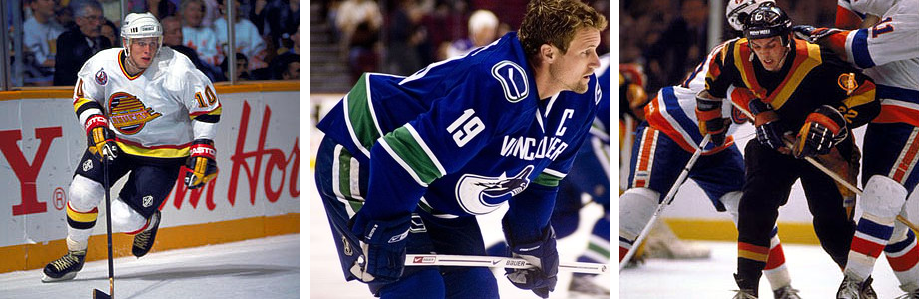
  In their 46 seasons in the NHL, the Vancouver Canucks have made the playoffs 27 times and won 10 division titles, 2 President's Trophies, and have made 3 Stanley Cup finals appearances. And while they have yet to capture Lord Stanley's Cup, they do lead the league in uniform changes. That's cool, right? So today I'm here to see what the ideal all-time roster of Canucks players would look like. The rules: only the players performances as members of the Canucks will count, and each player needs to have played at least 200 games with the team. Let's dive in!

Forwards
L-R: Bure, Naslund, Williams

Left Wing Centre Right Wing
Daniel Sedin (2000-present) Henrik Sedin (2000-present) Pavel Bure (1991-98)
Markus Naslund (1996-2008) Trevor Linden (1988-1997, 2001-08) Stan Smyl (1978-91)
Tony Tanti (1983-90) Ryan Kesler (2003-14) Todd Bertuzzi (1998-2006)
Gino Odjick (1990-98) Matt Cooke (1998-2008) Tiger Williams (1980-84)

The first line puts together three 100-point players known for their speed, scoring, and playmaking ability. Sure this line is devoid of physicality, but just the thought of having Bure play with the Sedin twins is enough to make any Canucks fan salivate. The second line puts together three players who were both the longest-serving captains in team history and at one point were the highest scoring players in team history. In addition to scoring ability, Naslund brings powerplay prowess and Smyl adds toughness. On the third line we have power forward Bertuzzi, two-way forward Kesler, and goal-scoring powerplay specialist Tanti. With the fourth line I broke the rules a bit (reassigned positions) and gooned it up with enforcers Odjick and Williams and pest Cooke (featured previously on the all-time Penguins lineup).
Honourable Mentions: Thomas Gradin, Alex Mogilny, Sergio Momesso, Brendan Morrison

Defencemen

L-R: Ohlund, Snepsts
Doug Lidster (1984-93) Jyrki Lumme (1990-98)
Matthias Ohlund (1997-2009) Ed Jovanovski (1999-2006)
Kevin Bieksa (2005-15) Harold Snepsts (1974-84, 1988-90)

The first defensive pairing consists of what I think are the best offensively gifted blueliners the Canucks have had: Lidster and Lumme. From a purely defensive viewpoint, I do think the second pairing, Ohlund and Jovanovski, are the greatest defencemen Vancouver has ever had. Ohlund brought excellent positional play and Jovo was a very good hitter and skater. The third pair benefits from Bieksa's toughness and leadership and Snepsts's intensity and killer moustache.
Honourable Mentions: Garth Butcher, Dennis Kearns, Sami Salo

Goaltenders

Luongo

Roberto Luongo (2006-14)
Kirk McLean (1987-98)

No contest here. While Captain Kirk was a beast in the playoffs, there's no denying the astonishing accomplishments of Lou. A 0.919 save percentage, a 0.56 win percentage, six seasons of 30-plus wins (including a career-high of 47), four seasons of 60-plus games played (including a career-high of 76), and the first goalie to be named an NHL team captain since the late 1940's.

Sunday, 1 October 2017

Movie Review -- It

  This weekend I saw It, a creepy clown horror movie based on Stephen King's novel of the same name. I've never read the book – nor any Stephen King book, for that matter – though I am somewhat fond of the 1990 miniseries even if it was kind of silly.
  This rendition of It isn't as funny as the previous one (though it's far from humourless), but it is significantly scarier. I don't watch too many modern horror movies, but it seems to me like most of them suck. But It doesn't, and here's why. For one thing the scares feel warranted. Most horror films today bombard the viewer with cheap and spontaneous jump scares to get some kind of reaction. Instead, It only uses jump scares after the proper tone has been set for the given scene. Not only that, but only a fraction of the scares found in this film are of the jumpy, computer-generated type; there's plenty of horrifying imagery and sounds throughout. In fact, the scene that I thought was scariest didn't even have a “Boo!” moment.
  Another thing that sets It apart from most modern horror is that it doesn't dump a load of unlikable characters whom you want to see dead. These characters are very well-acted and even better-written. I feel as is I knew each of these kids in real life when I was a kid. (At one point in life, I was the kid who constantly made “your mom” jokes.) Each of these kids has something up that you want to see resolved. And of course there's the evil clown himself, Pennywise, played by Bill Skarsgard. Needless to say this rendition of him is much creepier than Tim Curry's from 1990. I think it's in the unsettling way he moves about as well as his CG enhancements. It's a welcome update, even if he does kind of suck at catching the kids.
  And of course, when the audience cares about the characters, they'll care about the story. This one's story is more or less the same as the miniseries'. A group of seven outcast kids in a small town are terrorized not just by bullies but also an evil supernatural clown who exploits each of their greatest fears. With themes that deal with growing up, overcoming fear, and maintaining friendships, it's a horror movie that's got heart. The major difference is that the second timeline with the adults fighting It has been jettisoned and presumably left for the sequel.
  One last thing I'd like to mention is the setting. Instead of 1960, the setting's been updated to 1989. I'm guessing it's so that the sequel can take place roughly in the present day. I'm down with that; the late 80's were cooler than the early 60's! While It doesn't exactly hit you over he head with how 80's it is, it does manage to mix in a sweet cleanup montage! (The one thing that would've made that scene complete is Jules Winnfield and Vincent Vega.)
  So that's It, an engaging update of a classic supernatural horror. It hits all the right notes for this type of horror film. Is it the best Stephen King adaptation out there? I have no clue, but based on the ones I've seen I'd say that's no difficult feat. Can't wait for the sequel!

Grade:

Saturday, 30 September 2017

All-Time Team: Pittsburgh Penguins (1967-present)


  The NHL season is upon us! The most wonderful eight-ish months of the year. And so to celebrate, I'm doing some more renditions of what I believe are the all-time fantasy lineups of two NHL teams. For this week I'll be putting together the ideal historical lineup of last year's Stanley Cup champions, the Pittsburgh Penguins.
  But first, a brief history. The Pittsburgh Penguins were one of the first batch of National Hockey League expansion teams in 1967, which doubled the league's size from six to twelve teams. The team's first few years were pretty average for an expansion team, posting losing records and making sporadic playoff appearances in the late 1960's and early 1970's. However in the mid-1970's, the NHL realigned its divisions which benefited the Penguins greatly just when the franchise was dealing with bankruptcy. Around this time the Penguins also fielded some effective scorers such as the Century Line's Jean Pronovost, Lowell MacDonald, and Syl Apps Jr. Between 1975 and 1982 the team only missed the playoffs once, though they only ended up winning two playoffs series.
  Unfortunately the team bottomed out in the league standings in the 1982-83 and 1983-84 seasons. This brought back fears that the team would once again go through bankruptcy and possible relocation. The only hope of saving the team, it seemed, was Mario Lemieux, a superstar in the QMJHL and a foregone conclusion as to the #1 draft pick in 1984. In a controversial move, Penguins management made the decision to finish 1983-84 with the worst record in order to draft Lemieux. Super Mario proved a godsend to the struggling team, dazzling fans with his impeccable scoring prowess – which was only rivaled by Wayne Gretzky's – as well as serving as the nucleus around which a strong team could be built. The mid-to-late 1980's saw the acquisition of other big names such as Kevin Stevens, Randy Cunneyworth, and Tom Barrasso.
  In 1989, Pittsburgh made the playoffs for the first time in seven years. They missed the playoffs the following year, spending their off season acquiring even more talent: Ron Francis, Joe Mullen, Larry Murphy, and Ulf Samuelsson. But by far the most crucial acquisition during this time was the drafting of Jaromir Jagr who would go on to be one of the premier offensive superstars of the 1990's. This roster overhaul transformed the team into Stanley Cup contenders. Not surprisingly, the Penguins won the Stanley Cup two years in a row, in 1991 and 1992. The next few years consisted of excellent regular season performances (including a President's Trophy for 1992-93 and several division titles), Lemieux's play time limited by various health problems, and many deep playoff runs. Although they didn't return to Stanley Cup glory the Penguins remained one of the dominant NHL teams of the 90's, never missing the playoffs between 1991 and 2001.
  Mario Lemieux retired from professional hockey at the end of the 1997 playoffs, and so Pittsburgh's slow regular season decline began. At the same time, not only was home game attendance dwindling, but also the team had tons of debt to deal with and was forced to declare bankruptcy yet again in 1998. Then in December 2000, to everyone's amazement Mario Lemieux (who was by now the team's owner) returned to the ice, his scoring touch still with him. He lead the team to another playoff run, ending with a semi-finals loss to the New Jersey Devils.
  Due to financial restraints, Pittsburgh was forced to trade away Jagr and Alexei Kovalev, another high scorer. Combined with limited appearances from Lemieux, the team posted terrible regular season efforts, missing the playoffs four consecutive seasons. Attendance continued to suck and the Mellon Arena where the Penguins played was super old. In short, times were bad.
  Fortunately, history seemed to repeat itself. As was the case in the mid-80's, the Pens' poor performances in the mid-2000's resulted in some favourable draft positions, giving them star players like Evgeni Malkin, Marc-Andre Fleury, Jordan Staal, and of course Sidney Crosby, the Jaromir Jagr of his generation. These new additions made the Penguins exciting again – in spite of Lemieux's permanent retirement in 2006 – giving attendance a noticeable bump. Things were finally looking up; goals were being scored, the new arena was being built, and the team's financial problems were dealt with. The Pens finished the 2006-07 season with 105 points, whereas in the previous year it could only manage 58!
  The Penguins returned to the playoffs in 2007 and haven't left it since. They've had many deep playoff runs in the past 11 years, including 4 Stanley Cup finals appearances and 3 Stanley Cup championships (2009, 2016, and 2017). Needless to say, they're one of the dominant teams in the league right now.
  In their 49 seasons of existence, the Pittsburgh Penguins have made the playoffs 32 times and won 8 division titles, 1 President's Trophy, and 5 Stanley Cups from 6 finals appearances.

So today, let's take a look at the best Pittsburgh's 49 seasons has to offer. But first, the rules: only the players' accomplishments with the Penguins will be considered, and the roster is limited to players who have played at least 200 games with the team. So here we go.

Forwards
L-R: Lemieux, Stevens, Pronovost

LW C RW
Kevin Stevens (1987-95, 2001-02) Mario Lemieux (1984-1997, 2000-06) Jaromir Jagr (1990-2001)
Chris Kunitz (2009-17) Sidney Crosby (2005-present) Joe Mullen (1990-97)
Randy Cunneyworth (1985-89) Pat Boutette (1981-84) Jean Pronovost (1968-78)
Matt Cooke (2008-13) Bryan Hextall (1969-74) Nick Harbaruk (1969-73)
  
  You know you're dealing with a team with offensive depth when Evgeni Malkin doesn't make the cut. The starting centre is a complete no-brainer (unless you're a dumb kid who knows nothing about hockey history). Three-time league MVP, two-time playoff MVP, six-time leading scorer, ten-time 100 point scorer: I could go on, but when you get right down to it no player has ever meant as much to his team as Mario Lemieux. To his left is Kevin Stevens, one of the NHL's premier power forwards of his time. To the right is Jaromir Jagr, the other big scorer of 1990's Pittsburgh. On the second line we have capable playmaker Chris Kunitz (it's weird; the Pens have had a lot of outstanding right-wingers but not a ton of great left-wingers), Sidney Crosby, the 21st century's high-scorer, and the reliable goal-scorer Joe Mullen. The third line provides some defensive posture, with special teams specialist Randy Cunneyworth, tough guy/playmaker Pat Boutette, and the defensive forward who could still net 50 goals, Jean Pronovost. The last line is meant to get under the opposition's skin. We've got the defensive Harbaruk, the enforcer Hextall, and the pest Cooke.
Honourable Mentions: Val Fonteyne, Ron Francis, Pierre Larouche, Evgeni Malkin, Mark Recchi, Jordan Staal

Defencemen
L-R: Coffey, Gonchar

Paul Coffey (1987-92) Sergei Gonchar (2005-10)
Randy Carlyle (1978-84) Ian Moran (1995-2003)
Ulf Samuelsson (1991-95) Bryan Watson (1969-74)

  Our first defensive pairing puts together two of the most offensively-minded blueliners of their respective times: Sergei Gonchar and Paul Coffey, the second highest scoring defenceman in NHL history. The second pairing has Ian Moran and Randy Carlyle (who was also included on my all-time Winnipeg Jets team), two long-serving rock-solid defenders. And the third pairing has aggressor Bryan Watson and the infamous enforcer Ulf Samuelsson (previously listed on my all-time Hartford Whalers lineup).
Honourable Mention: Larry Murphy

Goaltenders
Fleury
Marc-Andre Fleury (2003-17)
Tom Barrasso (1988-2000)

  This was kind of a tough call. Both Tom Barrasso and Marc-Andre Fleury were great goaltenders for their respective times, but I'm giving the edge to Fleury because of his longevity and consistency. Fleury played 60 or more games in seven seasons and from 2006 to 2017 posted consistent save percentages between .905 and .921. While both goaltenders had some impressive seasons, Fleury simply had more of them, recording 30 or more wins in eight seasons to Barrasso's two.

So that was my all-time picks of Pittsburgh Penguins history. I hope you like it. Next time I'll be showing off my picks of the all-time greatest of my personal favourite NHL team. Stay tuned.

Saturday, 23 September 2017

In Defence of Batman & Robin (1997)

  Joel Schumacher is rightfully reviled the world over for what his films Batman Forever (1995) and Batman & Robin (1997) did to the Batman series of films. B&R is often regarded not only as one of the worst superhero films ever made, but one of the worst films ever made – period. Batman & Robin is undeniably a very bad movie.
  But I don't mind it that much.
  Now let me explain. B&R is a very silly film, but that's part of what gives it its zany charm. In the 1990's most comic book movies were trying really hard to be gritty and “serious”. But along comes Batman & Robin, a throwback to the campy 1960's television series. How can one not appreciate Mr. Freeze's themed hideout where his Eskimo henchmen partake in sing-alongs? It's a bunch of over-the-top fun silliness, a comedy. It's a film that's pretty funny at times, though not always intentionally so. One could even argue that this film is a spoof of comic book movies, one which is perhaps more relevant now than ever with the abundance of superhero flicks Hollywood is churning out. This is definitely true with the modern DC comics movies that try way too hard to be gritty and serious. Their attempt at subversive comedic action with 2016's Suicide Squad failed when what they should've done is just rerelease Batman & Robin! Compared to the serious Dark Knight trilogy and the joyless version of the Bat we got in 2016's Batman v Superman B&R feels like a breath of fresh air. It wasn't made to tell a deep story, explore philosophical themes, or study a complex character. It was made simply to give fans a good time.
  But as we all know not all fans did have a good time with Batman & Robin. I will admit there are plenty of stupid things to be found in this flick. There's the embarrassingly dumb Bat-credit card. The police of Gotham City are wholly useless. Robin is a whiny baby who does little besides complain. The special effects are shoddy. And the bat costumes all have nipples on them except for Batgirl's, the only costume that should've had them!
  But the film has plenty of lovably silly parts too. It's amazing how many ludicrously specific gadgets the heroes have on hand at exactly the right time. It's amusing to see actors George Clooney and Alicia Silverstone sleepwalk through their roles, not giving a f--- about anything. What's even more fun is seeing Uma Thurman overact her badguy stereotype. But even Thurman is out, um, “shined” by Arnold Schwarzenegger hamming it up as much as possible with his goofy makeup and neverending stream of bad puns. (Speaking of which, it's nice that a supervillain criminal who's trying to hold the city hostage so that he can get the funds he needs to cure his wife's advanced disease can still maintain a sense of humour. There's hope for everyone, it seems.)
  It's also true that by forcing the project to be more marketable and child-friendly (i.e. just doing it to sell toys and make money) Warner Bros. killed the Batman series. But to be fair this was a series that was already in decline. Ever since 1989's Batman, each movie got more or less progressively worse. Still, nobody wanted to see the series end up like this, even if it did go for more of a spoof tone.
In short, I have to reiterate, I don't think Batman & Robin is a good movie. It's definitely a bad movie, but it's a very watchable movie. If you're in the right mood, it's downright enjoyable. It's not good, but I've seen much worse.

  As far as I'm concerned, it's not even the worst Batman film. Stay tuned...

Saturday, 16 September 2017

Movie Review Repost -- Men in Black 3 (2012)

Sorry, guys. Still nothing new this week. I'll have something new for you next week but today we're going to take a look back at my review of Men in Black 3. I loved the first Men in Black when I was a kid and I still do today. Men in Black 2 was a lame disappointment overcome with a serious case of sequelitis. As for the third film, I haven't seen it since it was in theatres but I sure wouldn't mind watching it again. It was, and is still, pretty good.


  Better late than never, right? We've got a sequel that took ten years to get made, and you're reading a review that got written 20 days late. Sorry. But was this unexpected addition to the series worth it (the movie, I mean)?
  The answer is (probably) yes. It's good old sci-fi fun! The aliens are creative, the action scenes are astounding, and the special effects have improved in the ten years since the last film. The plot involves J going back in time to stop an alien supervillain (who also went back in time) from changing history and thus taking over the world. Unfortunately this means (for spoiler-ridden reasons) that K – Tommy Lee Jones' character – only has about 25 minutes of screentime.
  But that's OK, because instead we have Josh Brolin portraying the young agent K, and he does a spot-on job. He even looks just like Jones! Another example of great casting is Jemaine Clement as Boris the Animal. He was so good, I mistook him for Tim Curry with that really deep voice. And then there's Will Smith as agent J. He's still pretty good, but his performance isn't as funny or energetic as it used to be; it's starting to come off as a bit tired.
  When compared against the first Men in Black movie, this one isn't as funny, but it has way better special effects. Compared against the second movie, Men in Black 3 is much more memorable and it doesn't have a laughably hokey plot! If you like aliens, time travel, or just sci-fi in general, you'll quite like this one.

Final rating: three-and-a-half stars out of five.

Saturday, 9 September 2017

Movie Review Repost -- 30 Minutes or Less (2011)

Let's take a look back at one of my earliest reviews, 30 Minutes or Less, a forgotten comedy from 2011. I thought it was lame. I still think it was lame... I guess. It's not all that memorable so I can't really say I've thought about it much recently. Really the only notable thing about this movie is that Nick Swardson -- actor I hate the most-- isn't terrible in this. That's about all I can think to say of this film. Enjoy.


  This movie is bland. So bland that it's actually hard for me to think of things to write here. In fact, this must have been how the writers of the movie felt.
  30 Minutes or Less is the first comedy movie I've reviewed and the most important part of making a comedy is having an engaging plot. The plot is about a guy named Nick who is forced to rob a bank for someone named Dwayne because he is stuck to a bomb and he only has 10 hours to do it before its timer runs out. Sounds exciting, right? Except Nick and his buddy Chet keep getting caught in off-topic arguments that slow down the plot. OK, to be fair there are a few thrilling scenes like the bank robbery scene and the car chase scenes. But towards the end of the movie there's less and less jokes, and it feels almost like an action movie. The ending is really abrupt and leaves the viewer with a buttload of unanswered questions.
  Now for the jokes: some of them work, some of them don't work. By the end you'll have become used to the thoughtless automatic laughter you're emitting. You know those hilarious laugh-out-loud moments that you remember forever and quote whenever possible? Yeah, this movie has none of those.
  For the most part, the acting was pretty good. The only thing that bothered me was that Kate, Nick's love interest and Chet's sister, was so underdeveloped and banal. She's just there to look pretty and to cause tension between Nick and Chet.
  Overall, little effort was put into making this unremarkable snore-fest. There are better comedies out there. Watch them instead.

One and a half stars out of five. (Hey, I wrote a lot!)

Friday, 1 September 2017

Movie Review -- Baby Driver


   Here I am with a review of a movie that's been out for two months, possibly the most late review I've ever written for a current movie. My bad. But after seeing how much ass Baby Driver kicks, I just had to let everybody know about it.
   Baby Driver is about Baby, a young getaway driver and music lover who's having trouble leaving the heist business all while caring for his foster father and trying to go on dates with a waitress named Debora. It's a movie that delivers the goods when it comes to interesting characters, good acting – especially from the likes of Jamie Foxx, Kevin Spacey, and Ansel Elgort – good humour, and many thrilling car chases that make extensive use of stunt driving rather than CG phoniness.
   Perhaps the most interesting thing about Baby Driver is its sound design and editing. There's lots of popular songs in this movie – good ones, too – but 99% of them are contextual to the plot; the songs the audience is hearing are the same songs that the characters are listening to. When a character stops listening to a song, so does the audience. (I say 99% because there's one scene where R.E.M.'s “New Orleans Instrumental No.1” plays seemingly from nowhere.) When a character listens to music through only one earbud, the song half-fades away. Not only that, but a lot of the movie's sound effects and actions – like gunshots and car horns – are often timed to the beat of the song that's playing at the moment. It's a very different way of making a movie sound, and it lends a lot to Baby Driver's overall identity.
   The film's visual editing is also very energetic and tight. With lots of revolving shots and long following shots, the camera moves quite a lot, making every scene feel lively. If it seems like I'm talking more about Baby Driver's production than its plot and story, that's only because it's these elements that make the movie feel so fresh.
   And that's about all I have to say about Baby Driver, a really good crime-action film with a killer soundtrack. Its story may be a case of style over substance, but I'm not complaining when the overall product is presented with this level of joy and creativity. If you're looking for something fun, then hop on board.

Grade: